

This post contains affiliate links. If you purchase through these links, I earn a small commission at no extra cost to you. I only recommend products I actually use and have tested across multiple trips.
I used to treat compression socks like a boring add-on. I’d throw in whatever cheap pair I already had, then wonder why my ankles felt puffy after a long-haul flight and why I was doing that awkward shoe-loosen-on-the-plane shuffle before landing. The shift happened after a 14-hour flight from Los Angeles to Singapore, when I realized the wrong pair can turn a travel day into a small annoyance that lasts 24 hours.
Now I pack with a different rule: if I know I’ll be sitting for 8 to 12 hours, I bring socks that actually stay on, do the job, and don’t make me regret my life choices in economy. That’s where the Neo G Travel Compression Socks earned a spot in my bag. I’ve used them for 19 months across 8 countries, mostly on long-haul flights and airport-to-city transfers, and they’re the pair I keep coming back to when I want the least drama for the money. For around $15-30 when I bought them, that’s fair. Not glamorous. Just useful.
The Short Answer
If you’re flying economy and want compression socks that actually help on long travel days, I’d start with Neo G. I wore them on a 14-hour Los Angeles-to-Singapore flight and again the next day for the airport-to-city transfer, and they did their job without feeling flimsy.
My quick take: worth it if you want a budget-friendly pair for long-haul flights, only if you can deal with socks that take effort to pull on, and skip the idea of “one pair for everything” if your travel days are already swollen by the time you’re putting them on. I’d keep them in a carry-on for flights in the 8 to 12 hour range, especially when I’m traveling light and don’t want to waste bag space on extra recovery gear.
What I’d put in the same category: Neo G for long flights, the cheap drugstore pair only if you’re testing the idea, and anything thinner or looser gets ignored fast once I’m past hour 6 in economy.
What I Actually Pack for Long Flight Days


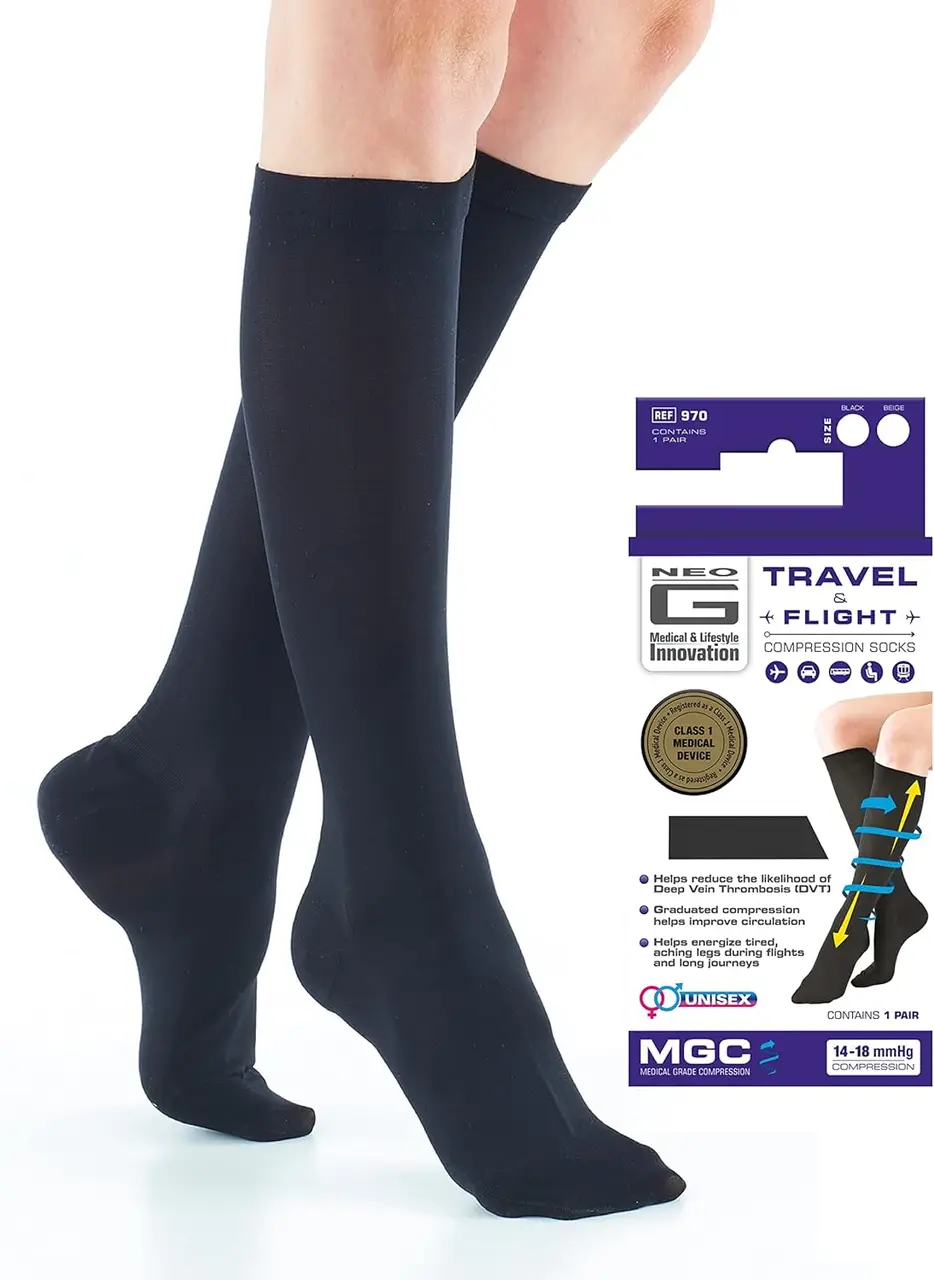
Neo G Travel Compression Socks
Neo G · $15-30 when I bought it
I use compression socks on long travel days when I know I’ll be stuck sitting for 8 to 12 hours. These do the job, but they are not the easiest to pull on and off when you’re tired.
- Worth knowing:
- They take effort to put on, especially if you are already swollen after a flight
- The tight top band can leave marks if you wear them for a full travel day
Check current price on Amazon (affiliate link)
Neo G Travel Compression Socks are the pair I kept after trying cheaper options first. Before these, I used a generic drugstore compression pair I picked up for about $10. They were fine for sitting at my desk, but on a red-eye to Europe they slid down by hour 5 and gave me that annoying folded-band feeling around the calf. I spent the last half of that flight yanking them back into place every time I stood up, which is exactly the kind of small travel tax I hate paying.
The winning difference with Neo G showed up on that Los Angeles to Singapore flight. I put them on before boarding, wore them through 14 hours in economy, then kept them on for the airport-to-city transfer the next day. The one thing they did better than the cheap pair was stay supportive without collapsing into a loose tube halfway through the trip. That sounds minor until you’ve spent 14 hours in a seat and your legs are begging for anything that feels consistent. Worth it.
After that trip, the problem changed from “my socks are useless by hour 5” to “I can forget about my socks and focus on the flight.” I’ve used them for 19 months now, and that consistency is the whole point. If you’re the kind of traveler who gets on a long-haul flight and wants one less thing to think about, this matters. The tradeoff is real, though: they take effort to put on, especially if you’re already swollen after a flight, and the tight top band can leave marks if you wear them for a full travel day. So no, I wouldn’t call them a chill airport lounge sock.
Field test details: I’ve worn them in humid summers in Southeast Asia and colder winter travel days where I had leggings, socks, and boots all competing for space in my carry-on. They fit inside a small shoe pouch with a T-shirt, underwear, and a charger cube when I was packing tight for a 4-day trip, which is exactly the kind of low-space situation I care about. The fabric has held up fine after months of use; I see wear more in the stretch than the look. The quirk is the same one every time: getting them on takes a minute, and if I wait until I’m already puffy, I pay for it. Only if you’re willing to put them on before you feel awful.
What it won’t do: it won’t feel effortless, and it won’t fix a full day of sitting if you put them on too late. If you have very sensitive calves or hate any top-band pressure, I’d look elsewhere.
Before: cheap drugstore compression socks that slid down and folded at the band on a long flight.
After: Neo G stayed in place through a 14-hour economy flight and the next day’s transfer, which is the whole reason I kept them.
Verdict: worth it if you want a no-nonsense pair for long-haul travel, not if you want the easiest socks to wrestle on at 2 a.m.
What I’d compare them against: the generic $10 drugstore compression pair failed me on a Europe flight by hour 5, and I also tried a looser “travel support” pair from a big-box store that felt basically decorative after the first few hours. That’s the difference: these are actually doing compression work when you’re trapped in economy, not just pretending.
What Didn’t Make the Cut
Generic drugstore compression socks were my first try, and they cost me about $10 plus one long-haul flight of annoyance. On a flight to Europe, the band rolled down by hour 5, and I spent the rest of the trip tugging at my calf every time I stood up to use the bathroom. Skip them if you want anything beyond a test run.
Loose “travel support” socks from a big-box store were worse in a quieter way. I wore them on a winter flight and barely felt any compression at all, which meant I still got that heavy-leg feeling after landing. They didn’t hurt, but they also didn’t solve the thing I bought them for, so that was money wasted on a product that looked more useful than it was.
Thick, cozy winter socks marketed as compression are a trap I’ve fallen for once. They were too bulky in my carry-on, too warm for humid summers, and they made my shoes feel tighter on the plane. I wore them for one transatlantic flight and regretted it by the time I got to immigration, which was enough for me to stop pretending they were a smart travel buy.
How It All Fits Together
For me, compression socks only work as part of a carry-on system, not as a random last-minute add-on. I pack them with my flight outfit so I can put them on before boarding, not after my legs already feel swollen. That matters more than people think. If I’m doing a humid summer trip, I keep the rest of the outfit light and let the socks do their one job. If it’s a cold winter route, I still keep the socks thin enough that they don’t fight with boots or take up half my shoe space.
The Neo G pair fits into that system because they’re reliable, not fancy. I can tuck them into the same pouch as my passport, charger, and a snack bar, and I don’t have to baby them. On a carry-on-only trip, that counts. I’m not looking for gear that feels impressive in a photo. I’m looking for gear that still works after a red-eye, a gate change, and a cramped seat in row 34. Worth it for that use case.
My one honest gripe is that they’re not the easiest pair to remove if I’m exhausted and already a little swollen after landing. That’s not a dealbreaker, but it is the reason I don’t wear them for every single travel day. I save them for the long ones where I know I’ll be sitting 8 to 12 hours and I want the payoff to be real.
I thought compression socks were just a paranoid travel hack until my ankles swelled so badly after a 14-hour flight to Singapore that I couldn’t fit into my shoes properly for 24 hours afterward. Turns out, the cheap $10 drugstore pair I’d been using slid down by hour 5 and basically stopped working, leaving me doing that awkward mid-flight adjustment shuffle the entire second half. The real lesson: spending $20-30 on Neo G socks that actually stay in place beats spending a whole day post-landing feeling bloated and uncomfortable.
FAQ
Are compression socks actually worth it for economy flights?
Yes, they’re worth it if you’re sitting for 8 to 12 hours or longer. I notice the difference most on long-haul flights where my legs feel heavy by landing time, and the socks help me avoid that puffy, sluggish feeling. If your flights are short hops under 3 hours, I’d skip them.
Do these work in hot weather, or do they feel miserable?
Yes, they still work in humid weather, but I only like them when I’m boarding with the rest of my flight outfit already set. I wore them in Southeast Asia and they were fine on the plane, but I wouldn’t wear a thick pair for a full sweaty travel day on foot. For airport-to-plane use, they’re fine; for all-day city wandering, I’d choose something lighter.
Are they hard to put on?
Yes, they take effort, and that’s the main downside. I’ve had to wrestle them on when I was already tired after a flight, which is annoying if you wait too long. My fix is simple: I put them on before boarding, not after takeoff.
Would you use them for winter trips too?
Yes, I still use them in winter because the compression benefit doesn’t disappear just because the weather changes. The only thing I watch is bulk under boots, since I don’t want a thick sock layer making my shoes feel tight. If you’re packing carry-on only, that smaller profile matters.
What should I skip if I only want one pair for flying?
Skip the cheap drugstore pairs and the fluffy “support” socks that look nice but don’t stay consistent. I tried both and got either rolling bands or almost no real compression, which is useless on a long economy flight. If you want one pair that actually earns its space, I’d pick Neo G again.
What’s the actual difference between cheap drugstore compression socks and something like Neo G for flying?
The cheap $10 pair I tried first slid down by hour 5 on my Europe red-eye, which meant I was constantly yanking them back up—that defeated the entire purpose. Neo G stayed in place and maintained consistent pressure throughout the flight, which sounds small until you realize you’re not fidgeting with your socks while already uncomfortable in economy. At $15-30, they cost double but actually do the job for the full 8-12 hours instead of quitting halfway through.
Are compression socks worth packing if I’m already traveling light and my luggage is tight?
I keep them in my carry-on specifically because they take almost no space and weigh nothing, so they’re not eating into my checked bag budget. For flights under 8 hours I skip them, but anything 8-12 hours? I’d rather leave behind something else than arrive with swollen feet that take 24 hours to normalize—that’s not worth saving a few ounces. The recovery time after a long flight is real, and compression socks actually shorten it if you wear them during the flight itself.
Do compression socks feel uncomfortable to wear, or is that something you adjust to?
They take genuine effort to pull on—I’m not going to pretend they slide on like regular socks—but once they’re on, you stop noticing them after about 30 minutes. The tightness is the point; if they feel loose or slack, they’re not doing anything. I wore them through airport security, the full flight, and into my transfer without wanting to rip them off, which tells me the discomfort-to-benefit ratio worked for me.
If I’m only flying economy occasionally, should I bother with compression socks or just deal with the swelling?
That swelling can ruin your first 24 hours at a destination, and I’ve learned that’s not worth saving $20 on socks. Even occasional long-haul flights deserve the right gear—I flew economy LAX-Singapore and wore them again the next day for the airport transfer because my legs were still recovering. If you’re doing economy every few months or less, Neo G at $15-30 is genuinely cheap insurance against that post-flight stiffness and puffiness that makes walking around a new city annoying.
How do I know what compression level (mmHg) I actually need for a flight from Nagoya to Tokyo or longer distances?
I’d recommend starting with 15-20 mmHg for flights under 4 hours, which is what I wear on my regular Nagoya to Kansai trips, but if you’re doing something longer like Nagoya to London (around 12 hours), you’ll want 20-30 mmHg for genuine deep vein thrombosis prevention. Most people don’t need medical-grade 30+ mmHg unless they have specific circulatory issues, so I usually suggest trying the mid-range first and seeing how your legs feel after landing. If you’re unsure, your doctor can recommend the right compression level based on your individual risk factors, and it’s worth the conversation before investing ¥3,000-5,000 in a quality pair.
 Emma Hayes
What I’d Rebuy Immediately
If I lost my travel socks tomorrow, I’d rebuy the Neo G Travel Compression Socks first. They’ve already survived 19 months, 8 countries, humid summers, cold winters, and one very long 14-hour economy flight without turning into junk. I’d also keep a cheap backup pair only for emergencies, but for the real long-haul days, Neo G is the one I trust.
That’s my honest answer for flying economy: not fancy, not soft, just useful. And for $15-30 when I bought them, that’s exactly what I want from travel gear.